
01 SHOW UP
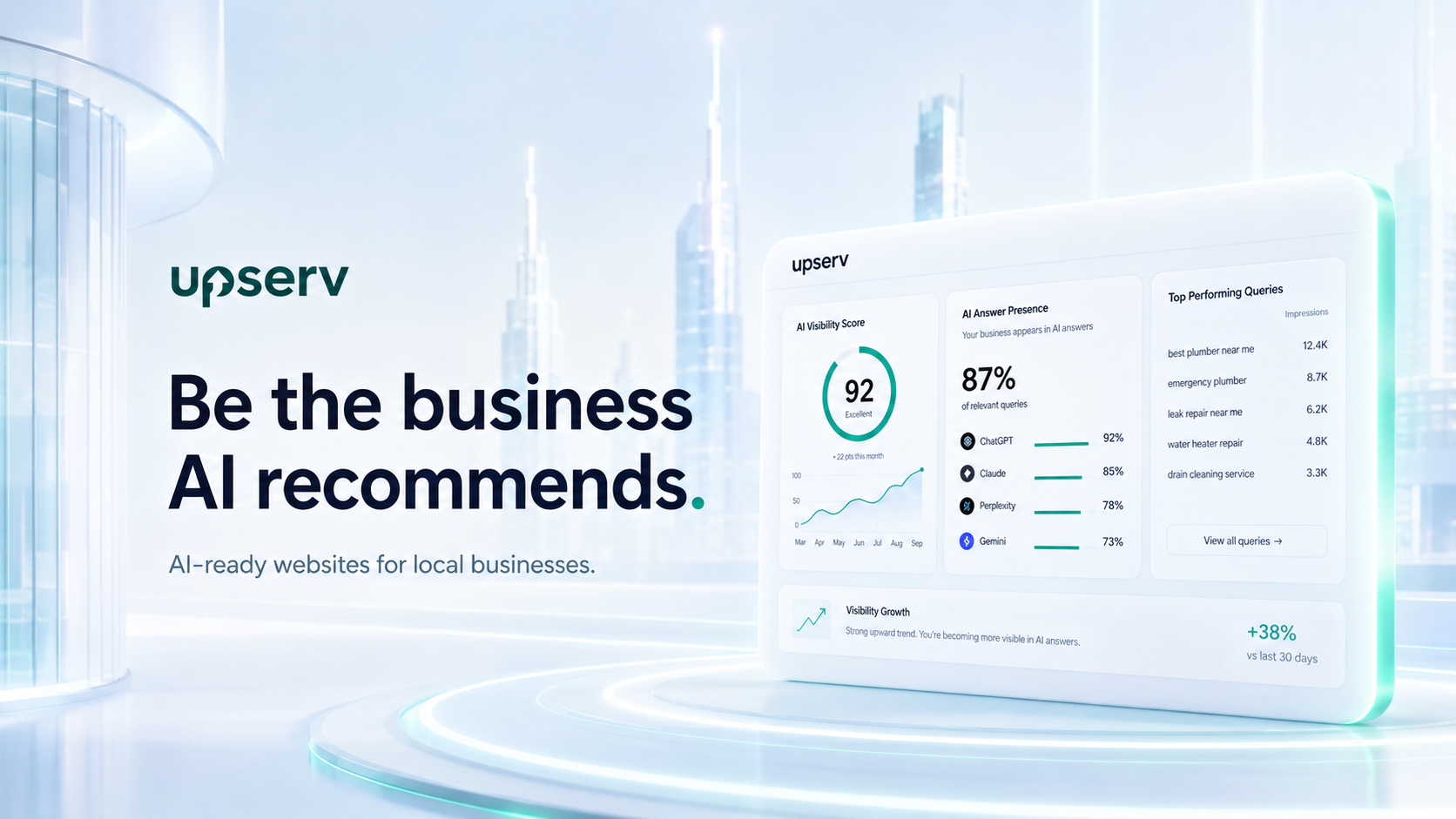
Your business appears when customers ask AI for businesses like yours.
We structure your services, locations, hours, pricing, and policies into clear fact statements AI systems can read.
Customers are no longer only searching through links. They are asking AI who to trust, who to call, and which business is worth choosing.
What AI needs to recommend you
Upserv structures business data into recommendation signals.
AI-readable pages. Citeable proof. Trusted local business facts.
AI understands
what you do
AI trusts
proof and clarity
AI recommends
your business
Your business appears when customers ask AI for businesses like yours.
We structure your services, locations, hours, pricing, and policies into clear fact statements AI systems can read.
AI understands what you do, where you operate, and why customers choose you.
We organize your About, Services, FAQs, and Reviews so AI can understand what you do, who you serve, and what makes you the right choice.
Your business becomes easier for AI to trust, cite, and recommend.
We keep your services, FAQs, reviews, and business facts current as AI search changes.
Most local websites make AI guess. Upserv turns scattered signals into clear, readable facts.
BEFORE UPSERV
What AI sees now
AFTER UPSERV
What AI sees after
We first rebuild your site so AI systems can understand it. Then we keep your business information, FAQs, reviews, and trust signals current as AI search changes.
STEP 1 · ONE-TIME SETUP
AI‑ready website build
We rebuild your site so AI systems can clearly understand what you do.
STEP 2 · ONGOING VISIBILITY
AI signal coordination
We keep your business current as AI search changes.
Start with the build. Stay visible every month.
We set up the AI-friendly foundation first, then keep your business current as the AI search landscape evolves.
Each vertical gets a website structured around the services, locations, proof, pricing, and questions AI needs before it can recommend a provider.
 DENTAL
 Customers ask
“affordable dentist in Houston that takes Aetna”
Pricing, insurance, and procedures structured so AI can recommend the right clinic.
 MED SPA
 Customers ask
“med spa with Botox under $400 near River Oaks”
Treatments, pricing, and credentials structured so AI can match the right provider.
 HOME SERVICES
 Customers ask
“emergency plumber 77002 same day”
Service areas, response times, and repair categories structured for urgent searches.
 AUTO
AUTO Customers ask
“transmission repair shop near Katy under $2000”
Repair categories, vehicle types, and turnaround time structured for the right shop.
 LEGAL
LEGAL Customers ask
“workers comp lawyer Houston, free consult”
Practice areas, fees, and case fit structured so AI can recommend the right attorney.
 HOSPITALITY
 Customers ask
“private event restaurant near me, outdoor seating”
Menus, hours, and event details structured so AI can match the right venue.
AI VISIBILITY LIBRARY
All guidesGuides, case studies, and checklists on how AI systems read websites and choose which businesses to recommend.
Most local business websites are written for humans and Google — not for AI. Here's the exact structure AI needs to surface you in recommendations.
Step-by-step: the site audit, the rewrite, the results. What changed and why AI tools started recommending them.
From ChatGPT and Perplexity to niche tools your customers are quietly using. A complete map of AI search in 2025.
12 things your site needs to be recommended by AI. Run through this before you spend another dollar on traditional SEO.
AI VISIBILITY LIBRARY · 200 ANSWERS
Explore how AI search works, what makes a website AI-readable, and how Upserv helps local businesses become easier for AI systems to understand, trust, and recommend.
AI visibility is how clearly and accurately AI assistants — ChatGPT, Claude, Perplexity, Google AI, Gemini, Copilot — can describe and recommend your business. It depends on the structure of your website, the clarity of your facts, and the trust signals AI systems can verify.
Customers increasingly ask AI tools "who should I call" instead of typing into Google. If AI can't describe your business clearly, it won't recommend you, no matter how strong your traditional SEO is.
They favor businesses whose websites contain clear service definitions, location signals, pricing context, credentials, and answers to common customer questions. The tighter and more verifiable the information, the more confident the AI feels recommending you.
Yes. SEO optimizes for ranking in a list of links. AI visibility optimizes for being named in a generated answer. The signals overlap, but the structure of the content matters more for AI.
ChatGPT, Perplexity, Google AI Overviews, Gemini, Claude, Copilot, and Meta AI all recommend businesses to varying degrees. Many AI search tools and voice assistants also pull from these systems.
If you serve customers who use AI tools to research services — and that's most adult internet users now — yes. Even one missed mention per week is a customer your competitor got.
Open ChatGPT or Perplexity and ask the kind of question your customers ask. If you don't appear, or appear with the wrong details, you have an AI visibility problem.
AI-ready means your website is structured around the questions AI needs to answer about you: what you do, who you serve, where, when, for how much, and with what proof.
Often yes. Many sites can be upgraded — clearer service pages, structured FAQs, better trust signals, schema markup — without a full rebuild. Upserv's setup handles either path.
AI tools recrawl pages on different cadences, but most visibility changes show up in 2–6 weeks. Some tools update faster after detecting structural changes.
The exposure itself is currently free. Setting up your site so AI can read and recommend you is the work — most businesses don't do it well, which is why being early matters.
Page text, headings, lists, FAQs, schema markup, structured pricing, location data, reviews, press mentions, and citations from third-party sources like Reddit, Wikipedia, and trusted directories.
Yes — AI tools cross-reference Google Business Profile data with your website. Make sure NAP, hours, services, and photos match what's on your site.
Yes. Reviews on Google, Yelp, industry-specific platforms, and on your own site are all readable. AI weighs them as trust signals when generating recommendations.
No — it extends it. Many AI tools still pull from traditional search indexes, so SEO is a foundation. AI visibility adds the structural clarity AI specifically needs.
Vague service pages, missing FAQs, no pricing context, locked content, low-trust signals, broken structured data, and abandoned profiles on third-party platforms.
It varies. Some crawlers visit weekly, others monthly. Major content updates and new schema typically trigger faster recrawls.
Rarely — AI prefers a single, decisive answer. The business that gives AI the clearest "raise your hand" signal for the query usually wins the mention.
Partially. You can test prompts manually, monitor Perplexity citations, and track referral traffic from AI sources in your analytics. Upserv tracks these signals monthly.
AI search adoption has crossed mainstream. Establishing positioning now — while AI placement is still organic — beats the upcoming era of paid AI sponsorships.
Google returns a list of links. AI search returns a written answer that names a few businesses. The competition is for being named, not for ranking.
It's replacing parts of how Google is used — especially for research, recommendations, and "who should I call" queries. Traditional search isn't going away, but its share is shrinking.
The fundamentals — clean structure, fast pages, real content, accurate metadata — still help. But AI search rewards plain, factual writing more heavily than keyword optimization.
Less than for SEO. AI tools understand intent, so writing naturally about what customers actually ask matters more than stuffing keywords.
It still helps as a trust signal, especially links from press, industry directories, and Wikipedia. But low-quality backlinks add no value and can backfire.
Yes, indirectly. Slow sites get crawled less and indexed less reliably, which limits AI tools' ability to read fresh content.
There's no public ranking. AI generates answers from the most relevant, trusted sources for that specific query. Your "rank" depends on the prompt.
The generated answer itself. The "search results page" for AI is a paragraph that names two or three businesses — not a list of ten links.
No. SEO and AI visibility share a foundation. Drop SEO and you lose the index AI tools partly rely on.
Through corroboration. AI looks for the same fact across multiple trusted sources. The more places confirm your information, the higher AI's confidence.
Some AI tools (Perplexity, Google AI) directly use search indexes. Others (ChatGPT) use a mix of training data, real-time browsing, and partner indexes.
Perplexity cites consistently. ChatGPT and Google AI cite when browsing. Citations matter for traffic — uncited mentions don't drive clicks.
Yes. AI fills gaps with plausible-sounding fiction when your real information isn't clear. The fix is publishing the truth, in plain language, in the right places.
They reduce some click-through, but if you're cited inside the Overview, brand exposure increases. Being named is the new "ranking #1."
They cross-reference business location, service area, and the user's implied location. "Near me" becomes "near the user" — your service area copy must be explicit.
Not in the same way. Users either get the answer or rephrase. There's no infinite scroll of competitors — being missed once is being missed.
Often, yes — for research and shortlisting. That's why adoption is growing, especially for local recommendations and comparison shopping.
Yes. Sitemaps help all crawlers — including AI tools that index real-time. Keep yours current.
Less than for SEO snippets, but it still anchors what AI thinks the page is about. Write it as a clean factual summary, not a marketing tagline.
Yes — but the work is shifting. The agencies that thrive will combine SEO fundamentals with AI visibility expertise. That's exactly the gap Upserv fills for local businesses.
Plain language, structured facts, explicit service definitions, real pricing context, clear FAQs, valid schema, and citable proof. AI doesn't need clever copy — it needs verifiable answers.
Yes. AI parses meaning, not flair. "We offer same-day emergency plumbing in zip 77002" outperforms "Your plumbing dream team."
Q&A format. AI tools recognize the structure and lift answers verbatim. Prose paragraphs about "common questions" are harder to parse.
It prefers complete pages over short or long. The right length is the length needed to answer the questions a customer might ask before choosing you.
Yes — even ranges or starting prices. Hidden pricing is a major AI visibility kill. AI prefers concrete numbers over "contact for quote."
Most AI tools can read PDFs but treat them as secondary. Critical content should live as HTML on a real page, not buried in a downloadable file.
Most do, but with delays and gaps. Critical facts (services, prices, location) should render server-side as plain HTML.
A small, specific glossary helps — especially for technical or regulated industries. AI uses glossaries to disambiguate terms.
For pricing, hours, service areas, and comparisons — yes. Tables let AI extract structured data cleanly.
Very. A logical H1 → H2 → H3 hierarchy helps AI map what each section answers. Skipping levels confuses parsing.
Yes — it's where AI learns who you are, who you serve, and what makes you different. A weak About page is one of the top three AI visibility gaps.
Always. Cities, neighborhoods, ZIP codes, and adjacent regions you actually serve. "Greater Houston area" is too vague for AI.
Indirectly, via alt text, captions, and surrounding copy. Don't put critical facts in image-only form.
Yes if video content carries claims about your business. Transcripts make that content readable to AI.
Yes. One unique, descriptive H1 per page. Multiple H1s confuse parsing.
Yes — these are some of the most cited facts in AI recommendations. List them in plain text on the relevant pages.
Long enough to answer who, what, where, when, why, how, and how much — usually 400–900 words plus a clear FAQ section.
For regulated services (medical, legal, financial), yes. Credentials are a key trust signal AI uses to gate recommendations.
Yes. AI is forgiving but consistent typos and misspellings reduce confidence and can break entity matching.
Through a mix of website content, Google Business Profile, Apple Maps, industry directories, review platforms, and citations from third-party sources.
Full address, service area, neighborhoods, ZIP codes, latitude/longitude (via schema), and phone area code. Consistency across all of these is critical.
Yes. Neighborhood-level service area pages are one of the highest-leverage local SEO and AI visibility tactics.
Yes. List specific ZIPs you serve. AI uses ZIP-level matching to handle "near me" and emergency-radius queries.
It infers the user's location from device or session context, then looks for businesses whose service areas explicitly include that location.
Yes — directly for Google AI, indirectly for others through scraped data and partner feeds. Keep your Google Business Profile current.
Build a dedicated page per city with localized services, examples, and proof. Don't rely on a single "we serve Texas" page.
Distance is one factor, but specialization, trust signals, and exact-match service area often outweigh it.
AI typically treats each location as a separate entity. Each needs its own page with its own NAP, hours, and reviews.
Not usually. One main site with a clear page per location is simpler to maintain and rank.
Name, Address, Phone — written identically across your site, Google, Yelp, directories, and citations. Inconsistencies confuse AI matching.
Yes. Even more for AI than for traditional local SEO, because AI tools cross-reference NAP across multiple sources to confirm an entity.
If they're published in your schema, on your contact page, and on your Google Business Profile — yes. Otherwise, AI guesses or omits the answer.
Use both regular hours (openingHours schema) and emergency-availability copy on the relevant service page. "24/7 emergency available" is a separate signal.
Yes — if your copy makes the distinction clear. Spell out which services happen at your location vs. at the customer's.
Very. "Emergency burst-pipe repair" is more discoverable than "plumbing services." Specificity wins long-tail AI queries.
Only if your service area page explicitly says you serve them. Otherwise AI defaults to local-only matching.
Single location, local phone area code, owner-named pages, local press mentions, locally-anchored reviews, and Local Business schema with one address.
Publish answers to those specific questions. "Best Botox under $400 near River Oaks" rewards a page that explicitly addresses that pricing band and that neighborhood.
Service area pages. Most local sites have one generic services page. Pages built per service × per neighborhood unlock long-tail AI queries.
FAQs are the format AI tools cite most often. They map cleanly to how customers ask questions, and they're the easiest place to publish citable proof.
For local businesses, 30–80 well-written FAQs typically cover the meaningful surface area. Quality and specificity beat raw count.
Ideally both. A master FAQ library plus contextual FAQs on each service page. AI handles deduplication.
2–5 sentences. Long enough to answer fully, short enough that AI can lift the answer verbatim.
Yes — FAQPage schema. It explicitly tells AI "this is a question and this is its answer," which improves citation rates.
Yes. Cleanly written, schema-backed FAQs are among the most citable content formats.
Quarterly minimum, more often for pricing and policy changes. Stale FAQs hurt trust signals.
Absolutely. Pricing FAQs are among the highest-leverage trust signals you can publish.
Yes. "What we don't do," "what disqualifies a customer," and "what insurance we don't accept" build credibility and prevent mismatched leads.
Mine your sales calls, support tickets, voicemail transcripts, contact-form submissions, and Google's "People also ask." Upserv sources from all five.
For citation density, yes. Blog posts are great for top-of-funnel; FAQs are better for being named in answers.
Yes. Use the exact phrasing customers use. AI tools match phrasing patterns when generating answers.
Yes — AI tools index and excerpt large FAQ libraries effectively, especially when properly structured with schema.
Lean conversational, but be precise. "Yes — we accept Aetna, Delta Dental, and Cigna" beats "Insurance? Sure, we got you."
Yes — voice queries are conversational, and FAQs structured as natural questions match voice patterns directly.
When relevant, yes. Internal links from FAQs to service pages help AI understand topical clusters.
For complex topics, yes. But keep nesting shallow — two levels max. Deep nesting hurts parsing.
Yes. "Implants typically range $3,000–$5,500 per tooth" is more useful to both customers and AI than "varies."
No — but they can extend it. About answers "who," FAQs answer "what," "how," and "why."
Pricing, insurance/payment options, hours, service areas, "do you do X," credentials, and "what to expect" — in that order.
Yes — heavily. AI uses reviews as a primary trust signal and often paraphrases sentiment when generating recommendations.
Google Business Profile, your industry's primary review site, and ideally on your own site with Review schema. Diversification across platforms strengthens trust.
Yes. Embedded reviews — with attribution and dates — give AI direct access to citable proof on your domain.
Both matter. Volume signals legitimacy; quality (length, specifics, recency) signals real human experience. Short generic reviews count less.
Yes — owners who respond signal active management, which AI weighs as a positive trust signal.
Yes, but less than written content. AI parses sentiment from review text more than from raw star averages.
Industry-specific platforms matter most. For local services, Google + your top vertical-specific site (Healthgrades, Avvo, etc.) is usually enough.
Yes. AI tools and review platforms increasingly detect inorganic patterns. Penalties range from filtered reviews to algorithmic suppression.
Yes — with attribution and a date. Quoted reviews function as inline social proof AI can cite.
They help less than verified reviews. AI weights them lower because they're not externally corroborated.
Yes — especially with named customers, real numbers, and dates. Case studies are some of the most quotable content for AI.
For visual industries (dental, med spa, home services), yes — with consent and captions. AI uses caption text for context.
Yes — especially in regulated industries. They're first-tier trust signals for AI.
Yes — with dates, sources, and ideally outbound links. Press mentions are high-trust citations AI heavily weighs.
They're marginal trust signals on their own. The underlying verification matters more than the badge image.
Yes — third-party press is one of the strongest signals. Even small local press placements compound over time.
You can't directly inject training data, but you can publish reviews on indexable platforms (Google, Reddit, industry sites) so they're accessible to AI tools that browse.
Selectively — when there's real news. Wire-distributed releases create citable mentions across syndicated outlets.
Yes — Reddit is heavily indexed by AI tools (Google has a partnership). Authentic Reddit visibility is a meaningful AI signal.
Consistent, specific reviews on Google with owner responses. Nothing else generates as much citable AI confidence as that combination.
Structured data — usually JSON-LD — that explicitly labels what your page is about. It tells AI "this is a business, this is its address, this is its phone."
Yes. Most major AI search systems use schema markup to disambiguate entities and improve answer accuracy.
LocalBusiness (or your industry-specific subtype), Service, FAQPage, Review/AggregateRating, and BreadcrumbList. Those five cover most use cases.
No. Schema labels content but doesn't create it. The underlying copy still has to answer questions clearly.
Most pages should — at minimum WebPage and Breadcrumb. Service, FAQ, and Article pages get more specific types.
A schema type that lists question-and-answer pairs in machine-readable form. AI tools cite schema-backed FAQs more often than plain HTML FAQs.
The schema type for physical-location businesses. Subtypes (Dentist, AutoRepair, RestaurantBusiness, etc.) give AI more precise classification.
Yes — one Service entity per offering, with its own description, area served, and price range.
It enables star display in some AI surfaces and Google rich results. The bigger benefit is signaling review legitimacy.
A format for embedding schema markup in a <script> block in your HTML. It's the recommended format — easier to maintain than microdata.
In a <script type="application/ld+json"> block, usually in the <head> or just before </body>. Either works.
Yes. Inaccurate schema (mismatched address, wrong hours) actively damages AI confidence. Schema must match visible page content.
Google's Rich Results Test and Schema.org Validator. Both are free and catch most errors.
No. Think of schema as labels on content. Without good content underneath, the labels point at nothing.
Not yet, but several emerging proposals (llms.txt, AI guidelines metadata) are gaining traction. Standard Schema.org types still cover most needs.
sameAs is a schema property linking your entity to other URLs representing it (LinkedIn, Wikipedia, your Google Business Profile). It boosts entity-resolution confidence.
Indirectly. OG tags primarily affect social sharing, but they also reinforce page-level metadata AI uses for context.
For blog posts and guides, yes. It helps AI understand author, publish date, and topic — useful for citation context.
Yes. openingHours is one of the most-read schema properties for local-intent AI queries.
It'll remain foundational, but new AI-specific protocols (llms.txt, structured-answer formats) will layer on top. Upserv tracks emerging standards as part of the monthly service.
Upserv builds AI-ready websites for local businesses and runs the ongoing signal work — reviews, FAQs, schema, press, and citations — that keeps them recommended by AI tools.
No. We're an AI visibility agency. SEO is part of the foundation, but our deliverable is being recommended by AI tools, not ranking on Google.
Local service businesses in five verticals: dental, med spa, home services, auto repair, and legal. Restaurants and hospitality are next.
Dental & specialty clinics, med spas, home services, auto repair, legal, and restaurants/hospitality. Each gets a vertical-specific website template and FAQ library.
Yes — that's included in the $1,000 setup. We build a new AI-ready site or upgrade your existing one.
Often, yes. We audit, then rebuild or upgrade depending on what's salvageable. WordPress, Webflow, Squarespace, and custom stacks are all supported.
A new or upgraded AI-ready website, a Training Document of your business facts, an FAQ library of 30–80 questions, schema markup, and onboarding to the monthly signal program.
Ongoing reviews coordination, FAQ updates, social and Reddit mentions, press releases, blogs, and signal pushes to 19 LLM-adjacent platforms.
Yes — all three. Most clients land on Astro or Webflow for performance and AI readability, but we work with your stack if you prefer.
One 60-minute onboarding call to gather facts, services, pricing, and proof. Then we draft the Training Document and you review. Setup deploys within 21 days.
No — and any agency that does is misleading you. AI placement is influenced, not controlled. We guarantee the work; the platforms decide the outcome.
Monthly we test prompt panels across ChatGPT, Claude, Perplexity, and Google AI for your category, and report citations, mentions, and recommendation share.
We rework the Training Document and FAQ library at no extra setup cost as long as you're on the monthly plan. Major restructures may extend timeline.
Yes — both. Setup includes copywriting and design for the AI-ready site. Monthly includes ongoing content (FAQs, blogs, releases).
Yes. We work within your existing brand — colors, type, voice, logos. Setup is a structural rebuild, not a brand redesign.
With your permission, yes — GBP is a core AI signal. We coordinate listings, hours, services, and photos as part of monthly work.
Yes — every FAQ we ship is wrapped in FAQPage schema. Service pages get Service schema. Your business gets LocalBusiness schema with the right subtype.
Yes — all part of monthly. Reddit-native engagement, press release distribution, and selective social mentions are part of the signal program.
You keep the website and Training Document. We hand off the schema, FAQ source files, and any tooling. No clawback, no lockout.
You do. Domain, hosting, code, and content all belong to you. We don't hold any of it hostage if you leave.
$1,000 one-time setup plus $150/month for ongoing AI visibility work. No long-term contract.
Yes — paid once at the start of the engagement.
Reviews coordination, FAQ updates, schema maintenance, monthly press release, blog post, signal pushes to 19 LLM platforms, and prompt-panel reporting.
No long-term contracts. Monthly pricing is month-to-month — cancel anytime.
Credit card, ACH, and wire transfer for setup. Monthly is auto-debit credit card or ACH.
Yes. Each additional location is $500 setup + $100/month. Multi-location work shares the central Training Document.
No — sales tax (where applicable) is added at checkout based on your state.
Typical setup is 21 days from kickoff. Faster if your existing site is in good shape; longer if a full rebuild is needed.
Most clients see first AI citations within 4–8 weeks. Major mentions and competitor displacement can take 90–120 days.
Setup deploys in week 1–3. Week 4 begins the monthly cycle: reviews check, first press release, first blog, first FAQ batch update.
A predictable monthly cadence: reviews & GBP audit (week 1), content drop (week 2), press/Reddit (week 3), reporting (week 4).
Yes — pay 12 months upfront and the 12th month is free. Annual is optional, not required.
30-day money-back on the setup fee if no value has been delivered. Monthly is non-refundable for completed months.
Within 30 days of setup, full refund minus any third-party costs already incurred (domain, hosting, premium tools).
Adding a single service or FAQ batch is included in monthly. Major service line additions (new vertical, new geography) are quoted as a small one-time scope.
No — the monthly fee is flat. Content volume scales naturally with the program over time.
No. Adding FAQs is part of monthly work. A typical client adds 5–15 FAQs per month.
Paid ad spend, premium third-party tooling, and major scope expansions (new locations, new verticals). Everything organic is included.
Yes. All site copy, FAQ writing, blog drafting, and press release writing is included. You review and approve.
Yes. Pricing is USD. International clients are welcome — payment is processed in USD.
No — and we won't make that promise. We guarantee the work and the structural foundation. AI tools decide what to recommend.
A measurably AI-readable website, an active signal program, and monthly visibility into where you appear, where you don't, and what to do next.
First AI mentions typically appear in 4–8 weeks. Significant traffic and recommendation share usually takes 90–180 days.
Citations on at least 2–3 major AI tools for your top customer queries, a fully populated FAQ library, and improved Google Business Profile visibility.
Becoming the only result for broad queries ("best dentist in Houston"), instant rank #1 in any tool, or controlling AI hallucinations 100%.
There's no fixed list to rank on. Each query generates a fresh answer with 1–3 named businesses. Your goal is being one of those names for the queries that matter to you.
Through prompt-panel testing (manual or scripted), Perplexity citation tracking, AI-source referral traffic in analytics, and review/citation volume changes.
Monthly reports include prompt test results, citation counts per AI tool, review velocity, and competitor mention deltas. A live dashboard is in development.
Yes. Stale-answer detection is part of monthly QA. Pricing changes, hours, and policy shifts trigger refresh cycles.
They can try. The work compounds — early structure, accumulated reviews, and citation history take time to match. Being early is the moat.
Going dark on reviews, killing your Google Business Profile, losing your domain, or letting facts go stale. We mitigate, but you have to keep the lights on.
They will, often. The fundamentals — clear facts, structured content, real reviews, schema — survive algorithm shifts. Tactics evolve with monthly work.
Almost certainly. Most AI tools will monetize through sponsored answers within 1–3 years. Establishing organic position now is leverage for that era.
Yes — adult, gambling, regulated supplements, MLMs, and any industry where we can't verify the underlying business is legitimate and licensed.
AI tool training-data choices, your competitors' real-world reputation, sudden algorithm changes, and your own response to operational issues.
No — usually it improves. AI-ready structure overlaps heavily with modern SEO best practices.
It works, but expect slower compounding. New businesses lack review history. We supplement with press, expert-content publication, and Reddit visibility while reviews build.
Yes. Review acquisition is part of monthly work. We don't fake reviews — we help you ask for them at the right moments.
Direct AI-source customer phone calls or form submissions. The customer telling you "ChatGPT said to call you" is the unmistakable signal.
Operational drift — they go silent on reviews, ignore monthly content drafts, or change pricing without telling us. The work compounds when both sides stay active.
No answers match your search. Try a different term.
COMPANY